Alaska Click and Cruise - A Hackberry Farm Nature Photography Workshop field report

Updated: Jul 21, 2025
Within minutes of pushing off from the dock in Petersburg, Alaska, it felt like we were already in the wilderness. On a well-appointed luxury yacht (The Northern Song), six guests, a crew of three, and I launch into the beautiful waters of Southeast Alaska. Along the way out to Frederick Sound, a group of sea lions lay on top of a channel marking bouy as if to wish us safe passage as we pass.
This is the first day of our Alaska Click and Cruise nature photography workshop, and the excitement is palpable. For the next seven and a half days, we'll cruise through the inside passage of Southeast Alaska in search of all of the natural wonders that the area possesses. We have an ambitious itinerary and a load of promise ahead of us. Luckily, Captain Shane, First Mate Bart, and Chef Katy are excellent at everything they do, and they facilitate a trip that's memorable, comfortable, and welcoming.

Being in Alaska in summer is cathartic and a welcome respite. While temperatures in the lower 48 simmer, temperatures are mild in Southeast Alaska, where the waters of the North Pacific Ocean churn cool water past the islands and continually churn the atmosphere, keeping things cool. During our trip, the temperatures hovered in the upper 40s to the upper 50s - alternating from pleasantly cool to a little chilly, depending on your internal constitution.
After embarking on our first day, we continually drifted past bald eagles, seals, and other water birds. It wasn't long before we saw the first of dozens of water sprays erupting from the ocean before us.
"There's a whale," exclaims someone. Pointing, the captain motions to an ephemeral cloud of mist, quickly dissipating into thin air. Soon, a black hump whale rolls across the water, breaking the barrier between air and sea. It's a humpback whale. She blows again, and then another smaller blow comes out behind her. She has a baby in tow.

The two swim side by side, surfacing ever so often with their black backs, and soon, the big one arches her back, and an enormous tale emerges with water cascading from it. A quick flip of the tail and she disappears into the deep - her baby following right behind her.
Everyone is amazed and looks around at each other. It's a special thing to see whales, and before the week is up, we'll have seen dozens and dozens.
What a whale does below the surface is only a guess. Chances are the whale is feeding on giant balls of herring that congregate en masse below the surface at varying depths. Humpbacks swim through the schools of fish, taking in as many as possible in a single gulp. Then, they force the water from their mouths through a specialized apparatus called baleen. Baleen is a pleated, expandable lower jaw perforated to allow water to flow out and only the fish stay behind. It's a remarkable adaptation.


As night draws near, we pull into the aptly named Serenity Bay. The boat anchors in the placid water, and a classically trained chef feeds us a gourmet meal. It's an apt end to an otherwise memorable day.
*
Southeast Alaska is wet. The peninsula, flanked by my mountains on the east, which create a border with Canada, is a rainforest. As clouds move in off the Pacific, the mountains squeeze the rain. As such, some areas get as much as 110 inches of rain annually. The surrounding trees and vegetation that grow on the mainland and the region's many islands are verdant, with giant trees draped in moss. The rain also feeds the hundreds of waterfalls we saw along the way. However, the rain was unusually persistent during the time of year we traveled. Therefore, we had a few gloomy patches of weather to endure, but in the end, the weather seemed to clear at the most opportune times.
It's all part of the experience.


We cruise, enjoy each other's company, and take in the sites throughout the week. It goes without saying that the scenery is incredible. Giant hemlocks grow down rocky crags to the point where the land meets the sea. The rainforest contains moss and thick peat that is spongy and otherworldly when you walk through it. Waterfalls cascade from the mountain tops into the water and splash upon the thin edge of the water where salt meets fresh. Every fold of the mountain and every snow-capped peak is a study of nature's perfection.
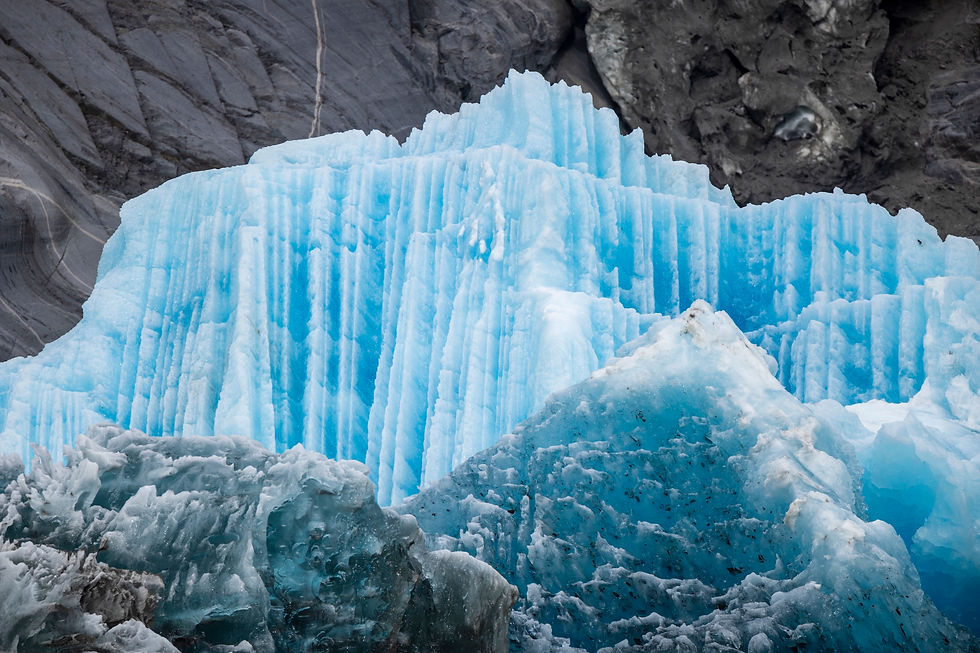
Deep down in one of the fjords we travel, chunks of ice populate the water course. These icebergs are the glaciers' progeny at the fjord's head. Calved off in a likely unseen event, the huge chunks of ice float down the fjord and provide temporary solace to the seals who seek them out to rest with their pups. Orcas don't swim up this far into the sea ice, so for now, loafing on a hunk of ice is the perfect spot for the seals.
It's also a scenic spot. The ice flow sports a hue of blue that I've never seen anywhere else in nature. Somewhere between cobalt and navy, this shade of blue is one only a poet can describe.
As we ease further up the fjord, I see the parent from whence the icebergs emerge. The immense Dawes Glacier stands silently as a wall of compressed ice that's thousands of years in the making. Formed from falling snowpack year after year, the glacier moves down this valley at a snail's pace. We're watching geologic formation in real time - albeit the changes are imperceptible, it's still awe-inspiring to be this close to an active glacier and hear the rumbles and pings of a feature that was here long before we were and will abide long after we're gone.


While we watch the glacier, a few smaller chunks of ice calve from its face. I'm not sure why, but it seems that the kittiwakes and terns understand where the next chunk of ice will fall, as they frequent the spot in advance of calving.
Soon, we head back out of Endicott Arm and head to Frederick Sound. We can't make it in a day, so like many nights, we tuck into a calm water bay where we anchor for the night. Each night, the activities vary: some explore the bays by kayak. In contrast, others jump in the skiff and ride around the area via motor boat. We drop crab pots one evening while another shrimp pot goes into the water. We dine on the bounty of our catch, which makes the activity much more special.
Being in a kayak and seeing wildlife at eye level from the boat is also special.
I think that's the ultimate takeaway from this excursion - the wildlife. We seemingly saw it all: sea lions, bald eagles, seals, sea otters, and an occasional bear. The whales are the most special animals (and I think I am speaking for everyone on board).


One minute, we're watching a pod of orcas hunting in open water. They've got calves in tow, so you can tell they are teaching their young lessons in teamwork and cooperation. I've seen orcas in the wild before, but seeing them again… Well, it never gets old.
On the last day, Captain Shane looks at me in the wheelhouse and says, "Do you see that?" I look forward. All I see is a smattering of gulls circling the water.
My eye is untrained, but Captain Shane knows what he sees. Soon, the water erupts before us. It's a dozen or so humpback whales bubble-feeding on herring. Bubble feeding is where a whale swims deep below the baitfish and encircles them with a "net" of bubbles to contain the biomass. As the fish, trapped by the “net”, swim to the surface, they are surrounded by a group of humpbacks who, with mouths open wide, rush to the surface to feed on the fish.
As the humpbacks repeatedly breach the surface, the guests and I congregate on the bow deck to watch and photograph. Bart deploys a hydrophone while Katy comes out to record the event.
The whale's song is something to behold. We all look at the speaker with wonder.
I turn to one of the guests and see that she's got tears in her eyes.
"I've always dreamt of hearing that," she says. "I never thought I would."
Her words resonate with me as the whales emerge again, but like her, I never thought I'd hear those sounds.
It's a song too beautiful to comprehend.

Additional Images


Comments