Moonlight on the Prairie - A Hackberry Farm nature photography workshop field report

Updated: Mar 23
“There it goes…” His voice punctuates the near blackness of night. While one of my guests on the Moonlight on the Prairie nature photography workshop is merely feet away from me, he and the rest of the participants are nearly invisible. It’s so dark out here.
It’s an eerie change of pace: just about three hours ago (when we arrived on this high, hardscrabble ridge in the heart of the Texas Rolling Plains), the landscape was bright. Well, as bright as it can be for 2:30 am. A full moon hung overhead, and a full blast of reflected sunlight painted the landscape a golden hue. Although technically it’s still dark outside, it’s easily bright enough to walk around without a light. The clear skies and bright moon cast our shadows across the gramma grass and prickly pear that dots this elevated perch on which we set up our cameras and look, unabated, to the west.

Ours wasn’t the only shadow being cast. Overhead, unseen by us, the Earth casts its shadow across cislunar space. It’s a magical misalignment of the earth, the sun, and the moon that’s fairly uncommon. In the span of a few hours, the moon shifts from bright and omnipresent to a dark orange and strange in appearance. It’s a total lunar eclipse, and they only happen in Texas every two to three years. But here we are, cameras clicking away as totality occurs.
“Wow, that’s beautiful,” he says, and the others in the group concur. As serendipity would have it, a group of photography friends booked every spot on this excursion, and for once, I am sort of the odd man out. They all know each other well, but I am the newcomer. I do what I always do to break the ice - I tell a story.
I tell the story of April 2024, when the total lunar eclipse appeared over Hackberry Farm in Northeast Texas. Just about everyone in the group saw the eclipse and shared their stories about it. These men are an easy group to mesh with and welcome me into their inner circle. But between the laughs and poignant moments we all share, there’s no doubt they’ll tell stories about the night when we all shot images for a few hours on Monday night, got 2-3 hours of shuteye, and then came back out in the darkness to do it all over again.

The lunar eclipse is a long one. It begins about 3 am and unfolds for the next four hours or so. Every so often, you look up and see a bigger and bigger wedge of the moon shadowed by the red-refracted umbral light.
Going, going, going, gone…
The moon stays in totality for some time. When totality commences, the ducks on the lake below, the owls, coyotes, and all of the other night critters who’d been auditorily active when the full moon shone bright, are now silent in the predawn stillness.
Then it happens: all the stars come out.
Washed out by the bright moonlight just minutes before, the sky is now dotted with both familiar and unfamiliar constellations. It remains largely that way until the day starts to break to our east.
As the landscape lightens with the coming sun, the eclipsed moon sinks further towards the horizon. We pack up and drive down the road to find a windmill and then shoot the last vestiges of the lunar phenomenon as the sun struggles to crest the eastern horizon.
The whole night was surreal. The whole week was surreal.
If you’ve never done it before, moonlit landscapes are an incredible way to do night photography. In fact, it’s my favorite way to do night photography. Milky Way shots are cool but a little passé. Moonlit landscapes - when combined with interesting foregrounds and perhaps a few clouds in the sky… Well, that’s surreal. And, surreal is what we are after.


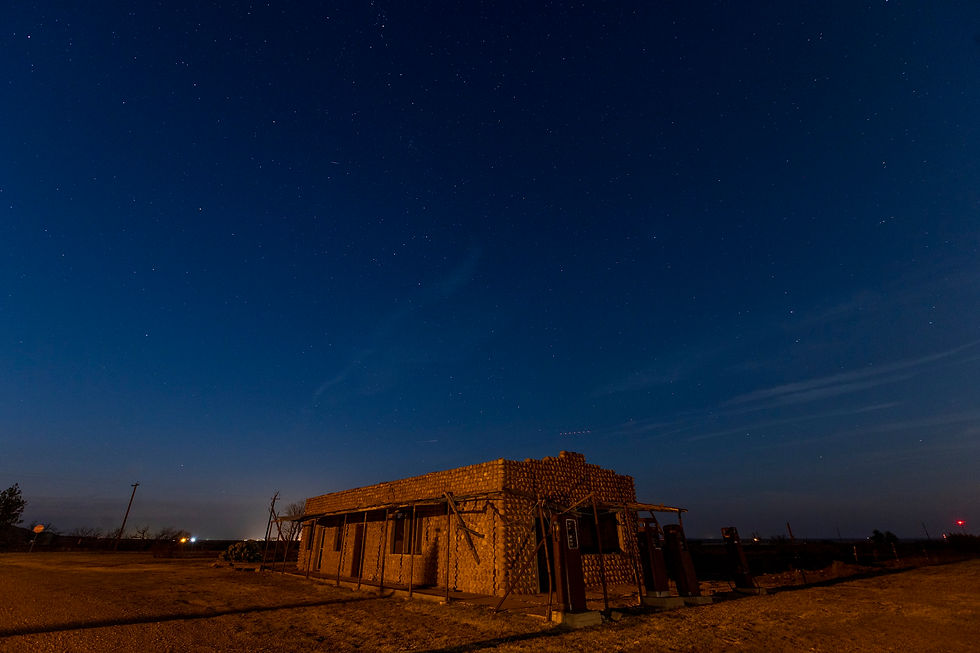
Each night we head afield to capture moonlight on the prairie. Moonrises, old buildings, trucks, rugged landscapes, and grain silos are all on the agenda. We crisscross the plains to find places of interest and take pictures that, I guarantee, heretofore, have never been shot before. Or at least in the way we’re doing it.
Some shots are lit only by moonlight. Others use colored lights placed in windows or just off camera. We experiment a lot. The results are pleasing and predictable. Each participant goes home with engaging images and has learned new techniques to add to their photographic toolbox.
On the last night of the trip, we ate supper at a local steakhouse. Earlier in the day, this area was placed in the bullseye for a severe weather outbreak. Everything is on the docket: wind, hail, tornadoes, and lightning. Before we walk into supper, we check the weather radar and accept that severe weather will miss us.
However, when we walk outside the restaurant, I see bright flashes over the buildings to the northwest.


“Before we head out, let’s take a look at what this storm is doing,” I tell them. Looking at the radar on a weather app, I see that a burgeoning cumulonimbus that we’d seen an hour earlier as we were out photographing at sunset had grown into a monster that was sliding northeast of us.
“We’ve got to take a look at this storm,” I tell them. They all concur. We drive two or three miles to a high ridge north of town. From here, we see the Rolling Plains prairie stretch about thirty miles, fading behind the earth’s curve. An immense mesocyclone floats past, spitting rain, hail, wind, a short-lived tornado, and copious lightning.
The jagged bolts of hot electricity raced through the sky and lit up the clouds around it. It’s hard to describe how it feels to watch such power on display. Mother Nature’s not angry. She’s just exercising a system of exchanging heat from the Earth’s surface and redistributing it in the upper atmosphere. It’s the nature of the weather's dynamic cycle during the unsettled season, spring.
We’re here to witness it, behold its power, and marvel.

ADDITIONAL IMAGES




Comments