Summer in Iceland - A Hackberry farm Nature Photography Workshop field report

For the past two days, the amount of sun we’d seen was scant. Upon arrival, a bit of rain spit from the heavy overcast, but not so much as to dissuade us from venturing afield. So far, we’ve already seen grand waterfalls and rolling fields of moss-covered lava. While the trip is in its infancy, it’s been a good one so far.
Just the evening before, we stood on a big cliff overlooking the vast North Atlantic. While the waves raged over the rocks and sea stacks lining the shores, the sound of it all was calming. High above the cacophony, I catch movement in the grass. While it’s late in the season to see them, a few puffins still hang around this steep outpost at the edge of the sea. They bob in and out of the grass and fly out to sea to feed on fish without warning.
Then it happened.
Out of an unseen nest hole mere feet from us, a puffin pops out into the wide open. He’s just about a dozen feet away, but there’s no need for a huge telephoto. A mere 200mm will suffice. So as he poses, we snap away and marvel at how unusual he is.

Puffins are special birds.
By evening, the skies began to clear, but by morning, they came back again. It’s the unsettled season here in the island country but the weather is perfect for our nature photography workshop. Fall is approaching fast, and the warm waters of the Atlantic Gulf Stream feed moisture that condenses against the ever-present cold-air masses that increasingly press down from the Arctic Circle.
Soon… Very soon, summer will cleave into fall and fall will cleave into winter. As Led Zeppelin sang in their hit The Immigrant Song, this is truly the land of the ice and snow. However, in the waning days of summer, we are privileged to see the dichotomy of verdant green fields contrasted by one of the largest ice fields I’ve ever seen.

The Vatnajökull Glacier ice field is part an immense national park of the same name and is comprised of 30 active glaciers whose constant meltwater flows into the ocean. By the time the sun breaks, we are standing along the shores of a vast glacier lagoon.
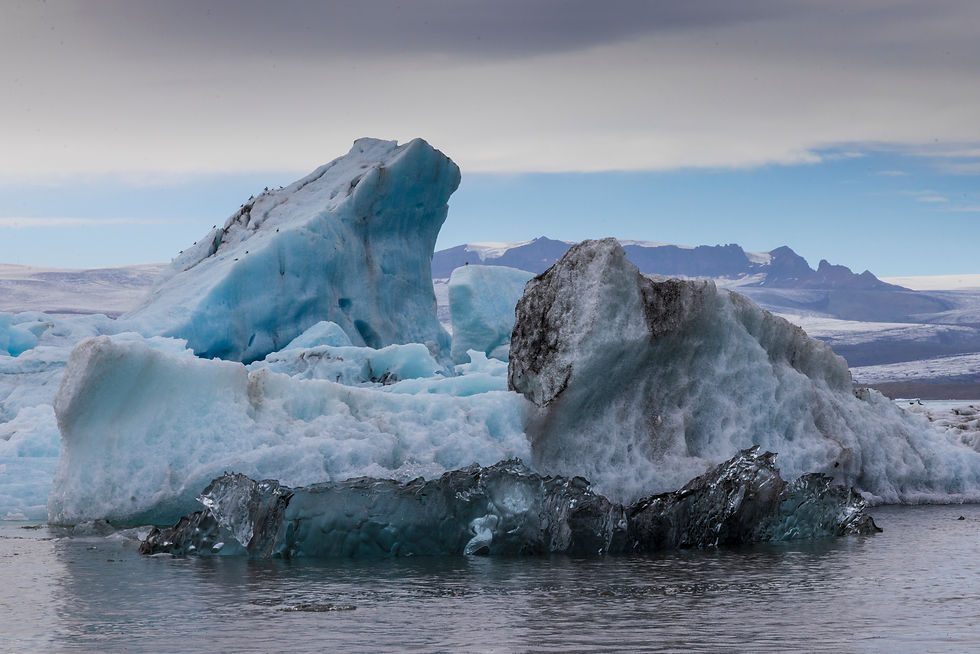
At the head of the lagoon, an active glacier constantly calves immense icebergs into the brackish lagoon. These icebergs (some the size of an immense house) ebb and flow in the lagoon with the rhythms of the ocean's tides.


When we stopped here the first time, there was a traffic jam of sorts in the lagoon. Outbound icebergs were bound at the head of the river by a pulsing tide that pushed in from the ocean. By the time we returned in the evening, the tide was outgoing, and a slew of freshly calved ice chunks were streaming along the black sand beach at the ocean’s edge. Immaculately clear, the small ice chunks were slowly melted by the barrage of waves that incessantly crashed ashore.
By the time the sun broke, it was low on the horizon. It was all worth the wait.
The small icebergs glowed from the backlighting, and in the distance, the sun burst from behind the clouds. Across the ice field in the distance, the sun lit up all it touched. The icebergs, the mountains, and especially the lagoon where the water was burnished with a soft shade of orange that contrasted nicely with the rest of the scene.

The once brief moment of sunshine - the first we’d seen the sun on the trip - was so worth it.
The next morning we continue. On a whim, we stop off at a sheep farmer's place for a visit. Icelandic sheep are omnipresent on the island and a unique breed of livestock brought by Vikings in the 9th century, well adapted to Iceland's harsh conditions. They are the ultimate triple-purpose breed- sturdy enough to provide lean, rich protein and milk, yet adapted also to provide a close-crimp wool that’s perfect for darning into clothing.
Icelanders live close to the land and have an identity as such. They’ve served for nearly a thousand years here by harvesting the bounty of the sea and the land. Therefore, it’s good to meet salt-of-the-earth people like the farmer.
His English is a bit broken, and he speaks it with a generous Icelandic accent. Even though he gets hung up on a word or two, his explanation of the processes in which a sheep farmer husbands his sheep is thoughtful and interesting.


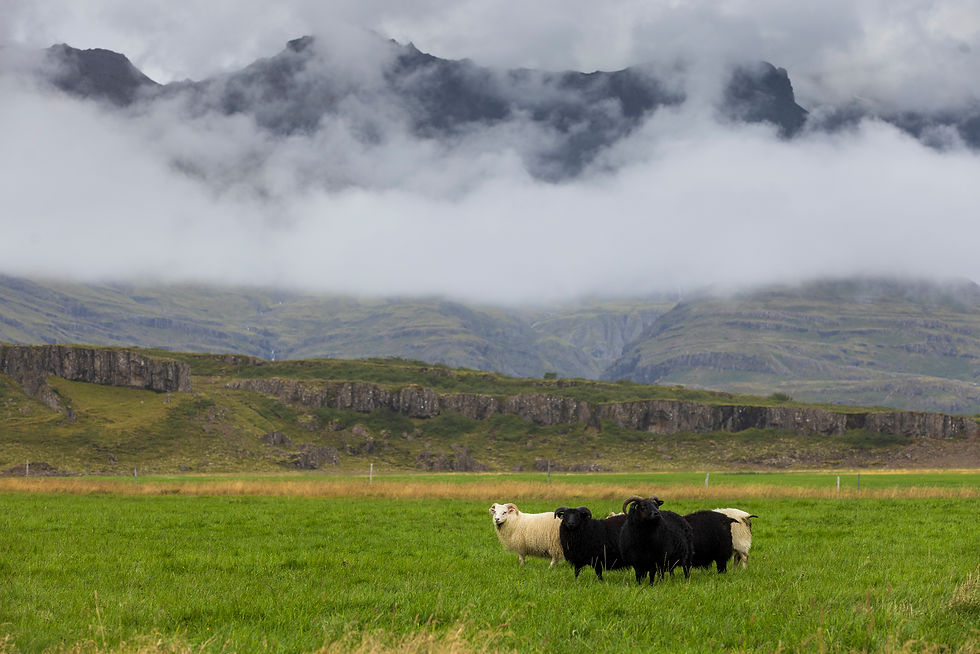
A few days later, we get to have a similar talk with a horse breeder and trainer who specializes in the only breed of equine on the island. The Icelandic horse.
Short-legged and sturdy, the Icelandic horse is long-maned and well adapted to the harsh winters here. They are also an unofficial mascot of the Nordic country. These horses were brought to the country a thousand years ago and are the only horse breed here. As such, when you look into the eyes of an Icelandic horse, you are looking into the eyes of antiquity; it’s an unbroken lineage of an ancient breed that’s changed little since it was introduced to the country.


Each day of this adventure, we stop and see grand waterfalls that look like they spill from the heavens. We visit now dormant volcanic cinder cones and thermal features that still bubble from the bowels of the earth below.
One waterfall, named Goðafoss, translates to Waterfall of the Gods - an apt name. It gets the moniker from the lawspeaker Þorgeir Ljósvetningagoði, who was in charge of deciding if Christianity would be introduced to the island in 1000AD. When he decided that Christianity was indeed the path of truth, he tossed all of his pagan statues into the river.

We swim in the hot springs and dine on delicious Icelandic cuisine. It’s a really immersive way to experience this beautiful country.
Towards the end of the trip, someone laments that they can’t remember all of the places we’d been to because we’d been to so many. That happens when you emphasize photography, natural beauty, and interesting cultural stops to help build a robust portfolio of the country. We stopped at a lot of places and experienced a ton of things.


The comment was meant as a positive affirmation of the power of photography and where it intersects with the fun of group travel.
In the end, Iceland was all I expected it to be: beautiful, engaging, welcoming, and intriguing. It’s one of those places that sticks with you long after you leave. It’s an explorer's dream to search for what’s around the next bend.
Iceland has plenty of that.
ADDITIONAL IMAGES









Loved, loved, loved reading this and seeing the photos.