The Badlands - A Hackberry Farm Nature Photography Workshops Field Report

The sun was just barely raking across the tops of the prairie grasses when we looked to the south and saw a generous herd of mama bison headed our way. Kicking double-time, the fresh red baby bison were doing their best to keep up with the nomadic herd that was moving at first light to search for new pastures in which to graze. Some of the babies couldn’t have been more than a week or two old, but they kept up with the rest of the herd. When the group would pause, some of the young would try to sneak a drink of mama’s rich milk that’s fortified with all that sunlight on fresh green prairie grass provides.
Across the way, we see pronghorns skipping effortlessly through the shortgrass while all around us, western meadowlarks and mountain bluebirds sing their happy songs to herald the start of a new day.

It’s a scene that’s played out for time immemorial. The sublimity of the moment is palpable, and each one of us on this nature photography workshop soaks it all in. It’s such a blessing to take a camera in hand and head afield to witness and document Mother Nature’s story.
The undulating prairie unfolds away from us for quite a piece until it gives way to ever-growing hills of granite. These Black Hills are legendary in our country’s historical canon. They’ve been a site of conflict and reconciliation. They are places where the greatest ideals of our country are celebrated in the grandest of ways. They are a spiritual place for the Native Americans who once (and still do) call these hills home. They are a reflection of who we were as a people and who we’ve become. They are a place whose natural beauty is preserved for future generations because wholesale development has been limited.

They are simply beautiful.
As we traverse the Black Hills, we’re treated to abundant wildlife and beautiful scenery that’s unlike most other places in the United States. The place has a distinct look about it, and it’s attracted people for millennia.
That’s why the hills once caught the eye of an artist to create perhaps the most ambitious of all public art. And soon, we end up at perhaps the most iconic of all of America’s monuments: Mount Rushmore.

Designed and executed by American sculptor Gutzon Borglum, the seemingly impossible tribute to four icons of American ideals was carved from granite over the course of 14 years. Upon its completion in 1941, the grand monument has stood as a testament to the four tenets that the American experiment hopes to achieve. It’s especially poignant to be here since this is the 250th year of our country’s independence from Great Britain.
Just down the road, we also see the enormous Crazy Horse monument, currently the largest stone sculpture under construction in the world.
Each place we visit (from the wild west town of Deadwood to the surreal rock monolith known as Devil’s Tower) helps paint a picture of a place uniquely American. On our visit to Devil’s Tower, the approach is a familiar one as everyone in our group remembers the scene from the movie Close Encounters of the Third Kind when the alien mother ship descended over the top of the immense volcanic core.


x


In the Lakota legend, the striations on the side of Devil’s Tower were made by a giant bear who clawed the rock when chasing young Lakota girls up the sides of the tower. Geologists, however, explain the tower’s creation as a magmatic intrusion whose surrounding rock slowly eroded away from the solid rock core, drifted down the Belle Fourche River, and flowed out onto the surrounding plains, creating rich plains that support a variety of biota.


Besides bison, perhaps there’s no more iconic symbol of the American plains than the prairie dog. These tiny rodents colonize broad swaths of prairie with their burrows. Once thought to be “the most injurious animal” of the plains, more enlightened science sees them for what they are: an important keystone species whose existence creates habitat, food, and shelter for as many as 120 different plains species. As important a species as they are, the truth is that they are incredible fun to photograph. Their constant antics provide plenty of photographic opportunities, and since we’re in baby season, the adorability quotient checks up to another level.
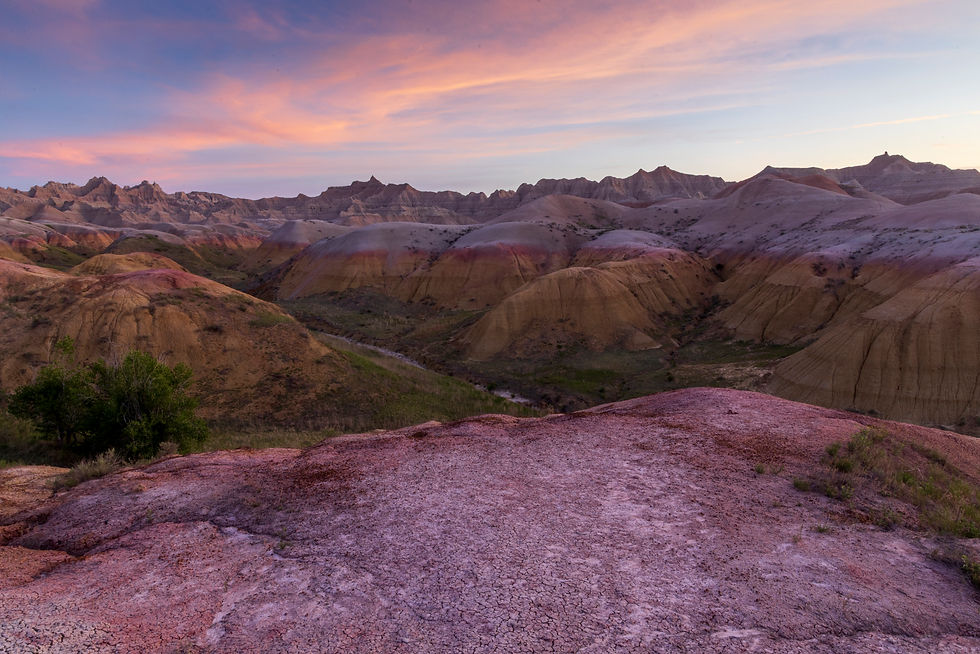
After a few days in the Black Hills region, we make our way across the plains to the Badlands. This national park is a gem. Essentially, as you travel south across the undulating shortgrass prairies from Interstate 90, five hundred million years of erosion created a grand escarpment that cleaves into the river basin below. Around the edges of the escarpment, the washes create immense and banded soil structures that are otherworldly in appearance. The hoodoos, fins, and erosional remnants seem to go on for miles. Each has its own texture and patterns, and light plays on them like nothing I’ve ever experienced. Add to the mix some incredible sunsets, and you can see why it’s all a landscape photographer’s dream.

While seeking iconic landscapes, we often pause to photograph big bison bulls dust-bathing or strolling through the badlands. Burrowing owls and pronghorns are on the stop-at-all-costs lists as well. They all hang out in close proximity to the gregarious black-tailed prairie dog, so each stop provides plenty of opportunities to document this special place in the American West.


All week, we connected the dots across the region to tell the story of this iconic patch of plains country. Seven days and six nights don’t seem nearly long enough. While we’ve accomplished everything we set out to accomplish in our photographic syllabus, there’s still so much to see.


This trip, like the others, ends in exuberant satisfaction. Each person who came along created their own interpretation of what the Black Hills and the Badlands represent to them. Each person brought their own technical and artistic skills to bear in order to be a witness to the places we not only visited but experienced fully.
That’s the way a trip ought to be.
Additional Images - The Badlands Nature Photography Workshop





Fabulous video, story, and images. P.S. - don't lose too much weight.